Furniture skin finishing equipment and edge banding production equipment are the two core machinery categories that determine the visual quality, durability, and market value of finished furniture panels — and investing in the right systems directly impacts production efficiency, material waste, and product consistency. Furniture skin finishing equipment applies decorative and protective surface treatments — including wrapping, laminating, and coating — to panel faces and profiles. Edge banding production equipment covers the entire process of manufacturing the edge banding tape itself, as well as the machines used to apply it to panel edges in furniture factories. Together, these two equipment categories define the surface quality standard of modern panel furniture manufacturing.
Furniture skin finishing encompasses all processes that apply a decorative or functional surface layer to MDF, particleboard, plywood, or solid wood substrates. The term "skin finishing" refers specifically to the application of thin film, foil, or veneer materials — the "skin" — that gives the panel its final appearance. The equipment category includes wrapping machines, membrane press (vacuum forming) machines, flat laminating lines, and UV coating lines.
Profile Wrapping Machines
Profile wrapping machines apply a continuous roll of PVC film, paper foil, melamine film, or real wood veneer around shaped profiles — door frames, skirting boards, cabinet moldings, and window frames. The substrate passes through a series of forming rollers that progressively wrap the film around the profile cross-section while hot-melt adhesive bonds the skin to the substrate.
Modern profile wrapping lines operate at 15 to 50 linear meters per minute depending on profile complexity and film type. High-end systems from manufacturers such as Saimpex, Homag, and Cefla can handle profiles up to 200mm in width and accommodate film rolls up to 1,200mm wide for wide flat components. Precise temperature control of the glue application zone — typically maintained between 160°C and 200°C for EVA hot-melt systems — is critical for consistent bond strength and preventing film bubbling or delamination.
Membrane Press and Vacuum Forming Machines
Membrane press machines (also called vacuum membrane presses) are used to wrap flat or three-dimensionally routed panel surfaces — particularly kitchen cabinet door faces with routed patterns, arch shapes, or curved profiles. A silicone membrane is drawn down over the component by vacuum, pressing the film or foil uniformly into every recess and contour of the routed surface.
The working table size of industrial membrane presses typically ranges from 1,300mm × 2,800mm to 2,100mm × 5,600mm, allowing full kitchen door batches to be processed in a single cycle. Cycle time per press operation is typically 3 to 8 minutes depending on film type, adhesive activation temperature, and component complexity. PVC foils of 0.2mm to 0.5mm thickness are the most common wrapping material, with acrylic and ABS films used for premium high-gloss applications.
Flat Laminating Lines
Flat laminating lines apply decorative paper, melamine foil, PVC film, or HPL (High Pressure Laminate) to flat panel surfaces using roller coating or curtain coating adhesive application followed by compression between heated or cold press rollers. These lines are the workhorses of flat panel surface finishing in high-volume furniture factories.
Throughput speeds for continuous flat laminating lines range from 20 to 80 meters per minute, with panel widths up to 2,100mm accommodated on wide-format systems. The adhesive system — PVA, hot-melt, or solvent-free PUR (polyurethane reactive) — determines bond strength, moisture resistance, and the minimum press time required for sufficient cure. PUR adhesive systems, while more expensive, provide significantly higher heat and moisture resistance than standard EVA or PVA systems and are increasingly specified for kitchen and bathroom furniture.
UV Coating and Finishing Lines
UV coating lines apply liquid lacquer or paint coatings to flat or shaped panel surfaces and cure them instantly using UV lamps, producing hard, scratch-resistant, and chemical-resistant surface finishes. These systems are used for high-gloss acrylic panels, anti-fingerprint matte surfaces, and textured effect finishes that cannot be achieved with film lamination alone.
A full UV finishing line typically comprises: sanding unit → filler/primer application roller → UV cure lamp → topcoat roller or curtain coater → final UV cure section. Line speeds range from 10 to 35 meters per minute. The UV curing energy output — typically 80 to 200 W/cm per lamp — must be matched to the coating chemistry and line speed to ensure complete cure without yellowing or surface defects.
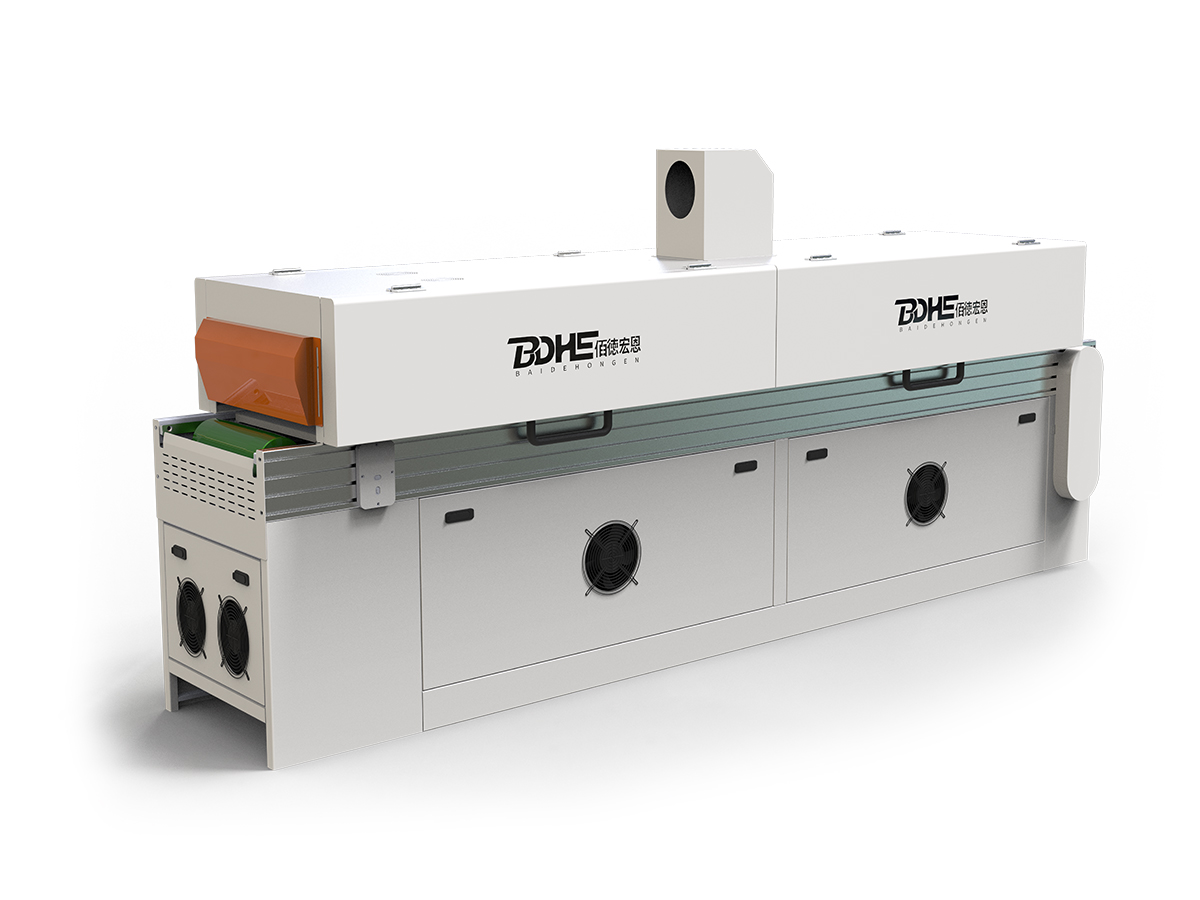
Edge Banding Production Equipment: Manufacturing the Tape
Edge banding production equipment refers to the industrial machinery used to manufacture edge banding tape — the strips of PVC, ABS, melamine, wood veneer, or acrylic material that are applied to the exposed edges of furniture panels. This is a distinct category from edge banding application machines used in furniture factories; edge banding production equipment is operated by materials manufacturers who supply the tape to furniture makers.
PVC and ABS Edge Banding Extrusion Lines
The majority of edge banding tape is produced by extrusion. A twin-screw or single-screw extruder melts PVC or ABS compound, forces it through a calibrated die to form the tape profile, then cools it through a water bath or air cooling section, before a haul-off unit controls tape speed and thickness consistency. The tape is then surface-printed, textured, or embossed before being wound onto rolls.
Standard PVC edge banding extrusion lines produce tape at 15 to 40 meters per minute, with thickness tolerances held to ±0.05mm on quality lines. Tape widths produced range from 19mm to 100mm+ for thick solid-color or wood-grain PVC strips. ABS extrusion requires higher melt temperatures (typically 220°C to 260°C) than PVC but produces a tape with superior impact resistance, dimensional stability, and better compatibility with PUR hot-melt adhesives — making ABS the preferred material for premium furniture.
Printing and Surface Treatment Units
Inline or offline gravure or digital printing units apply wood-grain patterns, solid colors, or decorative designs to the extruded tape surface. Gravure printing cylinders for wood-grain patterns can reproduce up to 8 colors in register, producing realistic timber grain effects that match corresponding face foils or laminates. After printing, a protective lacquer coat — UV-cured or solvent-based — is applied to provide surface hardness, scratch resistance, and chemical resistance.
Embossing units use engraved steel rollers to press texture patterns into the tape surface — replicating wood pore structure, brushed metal effects, or linen textures. Synchronous embossing (where the embossed texture is aligned in register with the printed grain pattern) is the highest-quality standard and requires precise synchronization between the print and emboss stations, typically controlled by servo-driven registration systems.
Acrylic and High-Gloss Edge Banding Production
High-gloss acrylic edge banding is produced by a co-extrusion process where a clear PMMA (acrylic) cap layer is simultaneously extruded over a colored ABS substrate in a single die, creating the high-gloss surface without the need for a separate lacquer coat. The PMMA cap layer is typically 0.15mm to 0.3mm thick and provides a gloss level of 90–100 GU at 60° — matching the high-gloss acrylic panel faces it is designed to complement.
Edge Banding Application Machines in Furniture Factories
In furniture manufacturing plants, edge banding application machines — commonly called edge banders — apply the pre-manufactured tape to panel edges automatically. These machines range from simple manual feed units for small shops to fully automated through-feed lines with CNC control for high-volume factories.
Edge Bander Machine Types and Capabilities
Table 1: Edge Bander Machine Types — Features and Typical Applications
| Machine Type |
Feed Speed |
Adhesive System |
Typical Use |
| Manual / Semi-Auto Edge Bander |
3–6 m/min |
EVA hot-melt |
Small workshops, custom furniture |
| Automatic Through-Feed Edge Bander |
12–25 m/min |
EVA or PUR hot-melt |
Mid-volume furniture factories |
| High-Speed Industrial Edge Bander |
25–60 m/min |
PUR hot-melt |
Large-scale panel furniture production |
| CNC Edge Banding Center |
Variable (CNC controlled) |
PUR hot-melt |
Custom shapes, curved panels |
Key Processing Stations on an Automatic Edge Bander
A fully equipped automatic edge banding machine processes panels through a sequential series of stations, each performing a specific operation:
- Pre-milling unit: Diamond-tipped milling cutters trim the panel edge to a precise, clean surface before tape application — critical for bond quality and edge straightness.
- Glue application unit: The adhesive pot melts EVA or PUR hot-melt and applies a controlled layer to the panel edge or to the tape backing. PUR systems operate at lower glue temperatures (around 140°C) but produce bonds with significantly higher moisture and temperature resistance than EVA.
- End trimming unit: Saws or routers trim the overhanging tape ends flush with the panel face after bonding.
- Top and bottom flush trimming: Cutting units trim the tape overhang on the top and bottom faces of the panel, leaving the tape flush with the panel surface.
- Corner radius scraping unit: Scraping blades create a smooth, rounded transition at the top and bottom edges of the applied tape — eliminating sharp corners and improving the quality of the finished edge profile.
- Fine trimming and profile scraping: Fine-finish trimming cutters and profile scrapers remove any remaining adhesive residue and produce the final edge profile.
- Buffing and polishing unit: Fabric or foam buffers polish the tape surface, removing minor tool marks and enhancing surface gloss — particularly important for high-gloss acrylic edge banding.
EVA vs PUR Adhesive in Edge Banding: A Critical Equipment Decision
The choice between EVA (ethylene-vinyl acetate) and PUR (polyurethane reactive) hot-melt adhesive systems is one of the most consequential decisions when specifying edge banding application equipment, as it directly affects product quality, machine complexity, and operating cost.
Table 2: EVA vs PUR Hot-Melt Adhesive Systems for Edge Banding
| Property |
EVA Hot-Melt |
PUR Hot-Melt |
| Application Temperature |
170–200°C |
120–150°C |
| Heat Resistance |
Up to ~60°C |
Up to ~120°C |
| Moisture Resistance |
Moderate |
Excellent |
| Bond Line Visibility |
Visible glue line |
Near-invisible ("zero joint") |
| Machine Complexity |
Standard open glue pot |
Sealed, moisture-protected pot |
| Adhesive Cost |
Lower |
Higher (2–3× EVA) |
| Best Application |
Standard interior furniture |
Kitchen, bathroom, outdoor furniture |
PUR systems require a sealed glue pot with nitrogen purging to prevent premature moisture cure of the adhesive during production pauses. This adds equipment cost and maintenance complexity but is essential for achieving the near-invisible "zero joint" glue line demanded by premium furniture buyers — where the edge banding appears to be a seamless continuation of the panel face rather than a separately applied strip.
Integrating Skin Finishing and Edge Banding into a Complete Panel Processing Line
In modern furniture factories, skin finishing and edge banding operations are increasingly integrated into a continuous, automated flow line to minimize handling, reduce labor costs, and ensure consistent quality. A typical high-efficiency panel processing sequence is:
- Raw board storage and automatic feeding — panel stacks are fed to the line by automated destacking systems.
- Surface sanding and preparation — wide-belt sanders achieve the surface smoothness required for consistent adhesive bonding in the laminating stage.
- Flat laminating / skin finishing — the decorative face material (melamine foil, PVC film, or veneer) is applied to one or both faces by the flat laminating line.
- Panel sizing / beam saw — the laminated large-format board is cut to the required furniture component dimensions.
- Edge banding application — sized panels pass through the edge bander to apply matching edge tape to all four sides in sequential passes or on a CNC machining center for complex shapes.
- Drilling and hardware insertion — CNC boring machines add shelf pin holes, hinge cup holes, and connector fittings.
- Quality inspection and packing — automated vision systems or manual inspection verify surface and edge quality before panels are stacked and packed for delivery.
Leading equipment integrators — including Homag Group, Biesse, SCM Group, and IMA Schelling — offer complete turnkey line solutions where all machines share a common control platform and data management system, enabling real-time production monitoring, recipe management, and predictive maintenance across the entire finishing line.
Key Buying Criteria When Selecting Finishing and Edge Banding Equipment
Equipment investment decisions in this category require evaluating multiple interdependent factors:
- Production volume and shift requirements: Calculate required daily throughput in linear meters or panels per shift. A factory running two shifts producing 800 panels per day has fundamentally different machine specifications than a custom shop producing 80 panels per day.
- Material range: Confirm whether the machine must handle thin PVC (0.4mm) through thick ABS (3mm) or solid wood veneer strips, as the glue application unit, trimming cutters, and feed pressure settings differ significantly between thin and thick tapes.
- Adhesive system choice: For kitchen and bathroom furniture, specify PUR adhesive capability from the outset — retrofitting a PUR system onto an EVA-only machine is rarely cost-effective.
- Automation and quick-change capability: For high-mix, low-volume production, evaluate how quickly the machine can switch between tape types, widths, and glue profiles — modern servo-driven edge banders can complete a full changeover in under 3 minutes with recipe recall.
- Dust extraction and environmental compliance: Both skin finishing and edge banding operations generate fine wood dust, adhesive vapors, and solvent emissions. Confirm that the equipment supplier can provide integrated extraction systems meeting local occupational health and CE/OSHA environmental standards.
- After-sales support and spare parts availability: Cutting tools (pre-milling cutters, flush trim cutters, scrapers) are consumable items with replacement cycles of 200,000 to 800,000 linear meters depending on material hardness. Confirm local distributor stocking and response time before committing to a machine brand.



 English
 中文简体
中文简体

