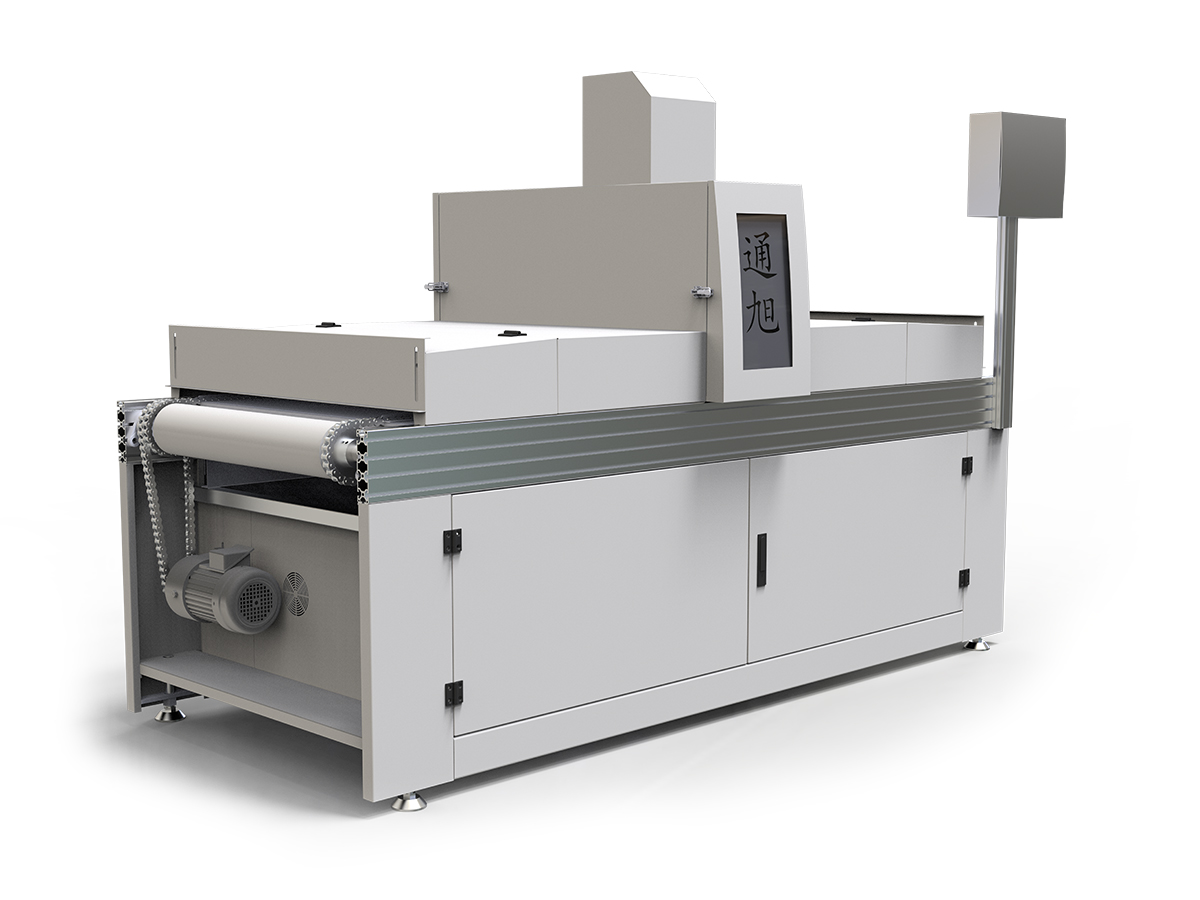
A single lamp UV curing machine uses one UV light source mounted above a conveyor to instantly harden UV-reactive coatings on flat panel materials as they pass underneath — turning a wet paint surface into a fully cured finish in seconds rather than the hours required by conventional air-drying or oven-cured coatings. This single-lamp configuration is the entry point for UV curing equipment, balancing lower equipment cost against the throughput and finish quality achievable with multi-lamp systems.
How UV Curing Differs from Conventional Drying Methods
UV-curable coatings contain photoinitiators — chemical compounds that remain stable under normal light but trigger a rapid polymerization reaction when exposed to UV radiation at the correct wavelength and intensity. Rather than evaporating solvents over time, the coating cross-links and solidifies almost instantly, which is why UV curing lines can process panels at line speeds far exceeding solvent-based or water-based finishing systems.
This mechanism has several practical implications for surface finishing operations:
- Cured surfaces can typically be stacked, packed, or further processed immediately after passing through the curing zone
- VOC emissions are significantly lower than solvent-based finishing, since UV coatings contain minimal or no volatile solvents
- Curing is highly dependent on UV intensity and exposure time reaching the coating uniformly — uneven lamp output or inconsistent conveyor speed produces partially cured or tacky spots
- Coating thickness directly affects cure depth — thicker coatings require either slower line speeds or higher lamp output to fully cure through the layer
Lamp Types and Wavelength Considerations
Single lamp UV curing machines generally use one of two lamp technologies: traditional mercury vapor lamps (with options for arc-bulb or microwave-excited variants) or UV LED arrays. Mercury vapor lamps emit a broad spectrum covering UVA, UVB, and UVC wavelengths and have historically been the standard for industrial finishing because most UV coating formulations are designed around this broad-spectrum output.
| Lamp Type |
Spectrum Output |
Typical Lifespan |
| Mercury vapor (arc) |
Broad spectrum (UVA/UVB/UVC) |
~1,000–2,000 hours |
| UV LED array |
Narrow band (typically 365–405nm) |
~20,000+ hours |
Comparison of common lamp technologies used in single lamp UV curing systems
UV LED arrays run cooler, consume less power, and last significantly longer than mercury lamps, but they require coatings formulated specifically for the narrower wavelength range — using a standard mercury-spec coating under an LED lamp can result in surface cure without full through-cure, leaving the underlying layer soft.
Material Compatibility Across Flat Panel Substrates
Single lamp UV curing machines are widely used across flooring, cabinetry, and decorative panel manufacturing because the process works on both porous and non-porous substrates without the absorption issues that complicate solvent-based finishes. Wood-based panels — flooring, cabinet doors, and wooden furniture components — benefit from UV coatings because the instant cure prevents the coating from soaking unevenly into grain or fiber, which can cause blotching with slower-drying finishes.
Non-porous substrates such as glass, acrylic sheet, metal decorative panels, and SPC (stone plastic composite) flooring require slightly different handling, since these materials don't absorb any coating and rely entirely on surface adhesion. For these substrates, surface pretreatment — corona treatment, plasma treatment, or a primer coat — is often necessary to ensure the UV coating bonds properly before curing, since a fully cured UV coating that hasn't adhered to the substrate will simply flake or peel under flexing or impact.
Stone and ceramic-based materials, including marble and tile, present a different challenge: their surface texture and porosity can vary significantly even within the same batch, so line speed and lamp intensity often need to be set conservatively to ensure full cure across the most absorbent areas of the surface without over-curing and yellowing the less absorbent areas.
Key Specifications to Evaluate When Comparing Single Lamp Systems
Beyond lamp type, several specifications determine how a single lamp UV curing machine performs in production:
- Lamp power (W/cm): Higher power per unit length of lamp generally allows faster line speeds for a given coating thickness, but excessive power on thin coatings or heat-sensitive substrates can cause warping or surface defects.
- Conveyor width and speed range: Determines the maximum panel size and the throughput achievable — line speed is typically adjustable to match coating thickness and substrate type.
- Cooling system: Air or water-cooled reflector housings prevent heat buildup that could damage heat-sensitive substrates like thin veneers or certain plastics, and also extend lamp life.
- Reflector design: Elliptical or parabolic reflectors focus UV output toward the panel surface, improving curing uniformity across the width of the conveyor and reducing the energy lost to surrounding areas.
For operations expecting to scale up production volume or move to thicker, multi-layer coating systems, it's worth confirming whether the curing unit can be paired with additional lamp modules later — since multi-lamp configurations allow staged curing (a lighter initial cure followed by a full final cure) that improves finish quality on demanding substrates like piano cabinets and high-gloss decorative panels.



 English
 中文简体
中文简体

