A two-axis brush machine is an industrial surface treatment system that uses two independently driven brush roller assemblies — rotating on separate axes — to apply, spread, or texture coatings on flat workpieces such as flooring panels, furniture boards, door skins, and engineered wood substrates. Unlike single-roller coaters that work in one direction only, the dual-axis configuration allows the machine to process the workpiece surface from two angles simultaneously or in rapid sequence, producing more uniform coating distribution and superior texture penetration.
The two axes typically refer to the main feed direction (the X-axis, along which the workpiece travels through the machine) and a cross-direction or oscillating axis (the Y-axis, along which one or both brush rollers traverse laterally). Some configurations use contra-rotating paired rollers on the same horizontal plane rather than orthogonal axes — the term "two-axis" in this context means two discrete brush spindles with independent speed and direction control.
Core mechanical components of a two-axis brush machine include:
- Brush roller assembly — cylindrical rollers fitted with abrasive filaments (nylon, sisal, or wire) or application filaments (foam, felt, or horsehair), selectable based on the process requirement
- Variable-speed drives — typically servo or inverter-controlled motors that allow independent RPM setting for each brush axis, enabling fine-tuning of coating spread, pressure, and surface texture
- Infeed and outfeed conveyor system — rubber-covered or chain-driven transport belts that carry boards through the machine at controlled speeds, typically 5–25 m/min depending on coating viscosity and substrate type
- Height-adjustment mechanism — motorized or manual roller gap control to accommodate different substrate thicknesses, usually with digital readout for repeatable setup
- Coating supply system — a metered pump or gravity feed trough that delivers a controlled amount of coating material (UV lacquer, oil, stain, wax, or primer) to the brush interface
The dual-axis arrangement is particularly effective for open-pore finishes on wood, where the coating must be worked into the grain rather than simply deposited on the surface. By combining a forward-rotating main roller with a counter-rotating or laterally oscillating second roller, the machine fills grain valleys uniformly — a result difficult to achieve with a single-pass roller coater or manual application.
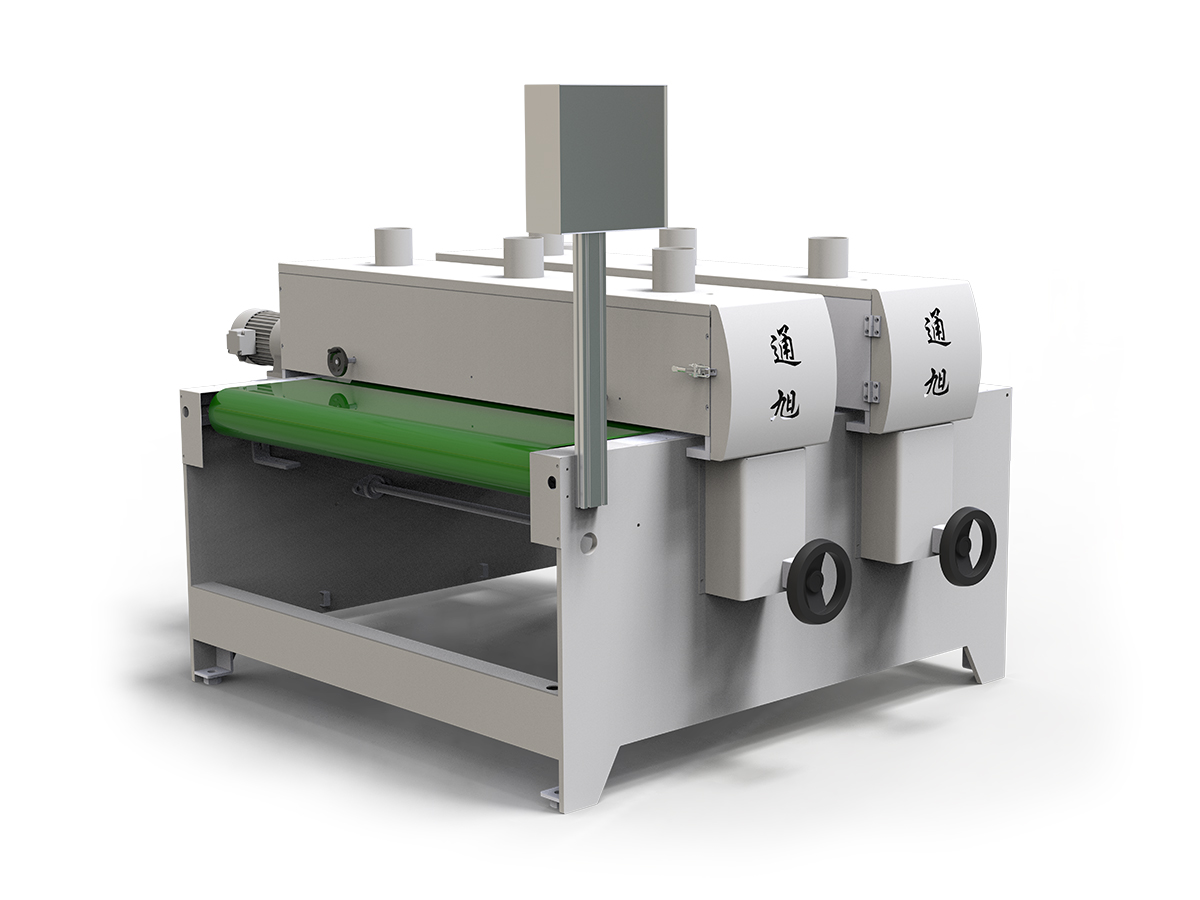
Key Applications in Furniture and Floor Coating
Furniture and floor coating equipment based on the two-axis brush principle is deployed across a wide range of production environments, from high-volume engineered flooring plants running 50,000+ m² per day to mid-sized furniture component lines processing panel parts and door skins. The machine's value lies in its ability to handle multiple coating functions within a single inline pass.
The primary application areas are:
Hardwood and Engineered Flooring
In flooring production, two-axis brush machines are most commonly used for pore-filling and grain-opening operations prior to UV curing lines. After an initial sealer coat is applied by roller coater, the brush machine works the wet coating into the wood grain at controlled pressure before the board enters the UV oven. This ensures the cured finish bonds to the full profile of the wood surface rather than bridging over open pores — a critical factor for adhesion durability on species like oak, ash, and walnut, which have pronounced open grain structures.
A second application in flooring lines is brushed antique texture finishing — using abrasive nylon or wire filament rollers to mechanically distress the wood surface before coating application, creating the hand-scraped or wire-brushed aesthetic popular in residential and commercial flooring segments. Production speeds in this configuration typically run at 10–20 m/min with brush RPM between 300 and 800.
Furniture Panels and Components
For flat furniture panels — MDF doors, cabinet fronts, table tops, and bed headboards — two-axis brush machines serve as stain and oil application units in both water-based and solvent-based finishing lines. The dual-roller action ensures even color distribution across the full panel width without streaking, which is a common failure mode on single-direction coaters when coating viscosity or conveyor speed varies slightly.
In high-gloss UV finishing sequences for furniture, a two-axis brush machine is often positioned between the filler coat and the top coat roller stations. Its function at this stage is to sand the cured filler coat lightly using fine abrasive filaments (equivalent to 320–400 grit), removing raised grain and surface irregularities before the top coat is applied — eliminating a manual sanding step and reducing labor cost significantly.
Priming and Sealing of Raw Boards
Raw MDF and particleboard absorb coating unevenly due to density variation across the panel. Two-axis brush machines used as primer distribution units help compensate for this by mechanically working the primer into the board face under controlled pressure, producing a more uniform sealed surface that accepts subsequent coats evenly. This application is common in flatline finishing systems for kitchen cabinet and ready-to-assemble furniture production.
Two-Axis vs. Single-Axis Brush Machines: Performance Comparison
The decision between a single-axis and two-axis brush machine comes down to the complexity of the surface treatment task, the substrate type, and the production volume. For straightforward stain wiping or light abrasive brushing on uniform substrates, a single-roller unit may be sufficient. For coating penetration, texture uniformity, and multi-function operation, two-axis machines deliver measurably better results.
| Parameter |
Single-Axis Brush Machine |
Two-Axis Brush Machine |
| Coating uniformity |
Good on smooth substrates |
Excellent on open-grain wood |
| Pore-filling capability |
Limited |
High — dual-direction action drives coating into grain |
| Functions per pass |
1 (apply or abrade) |
2 (apply + spread, or abrade + clean) |
| Streak risk on wide panels |
Higher at low viscosity |
Lower — cross-direction roller compensates |
| Suitable for texture brushing |
Yes, unidirectional only |
Yes, including cross-brushed patterns |
| Machine footprint |
Compact |
Larger (typically 1.5–2× longer) |
| Typical installed cost |
Lower |
Higher, offset by reduced downstream rework |
Table 1. Single-axis vs. two-axis brush machine comparison for wood coating applications
In high-output flooring lines where surface quality directly affects product grade and sellable yield, the additional capital cost of a two-axis machine is typically recovered within 12–18 months through reduced coating waste, lower manual rework labor, and fewer defects reaching the final inspection stage.
Brush Filament Selection: Matching the Tool to the Process
The performance of a two-axis brush machine depends heavily on brush filament specification — the material, diameter, fill density, and trim length of the bristles on each roller. Selecting the wrong filament type is the most common cause of poor finish quality, excessive coating waste, or accelerated roller wear in furniture and flooring coating lines.
The main filament categories and their recommended applications:
- Natural sisal — stiff, coarse fibers derived from agave plants; used for aggressive pore-opening and grain-raising on raw timber before coating; excellent abrasive effect without metallic contamination; typical diameter 0.3–0.6 mm
- Nylon 6.12 or nylon 6.6 — the standard choice for coating application and distribution; resistant to UV lacquers, water-based stains, and most solvents; available with abrasive grit loading (silicon carbide or alumina oxide) for combined application and sanding functions; diameter range 0.15–0.5 mm
- Horsehair and tampico blends — soft natural fibers used for final oil and wax distribution passes where gentle spreading without substrate abrasion is required; commonly specified for hardwax-oil and Rubio Monocoat style finishes on sensitive wood species
- Stainless steel wire — for aggressive mechanical texturing of softwoods and pine to enhance grain definition before staining; not compatible with coating application due to metallic particle contamination risk
- Foam or felt segments — used in application-only configurations where zero abrasion and maximum liquid transfer per pass are the priorities; common for high-build primer application on MDF
Brush rollers in continuous production should be inspected every 200–300 operating hours for filament wear and deformation. A worn brush roller with splayed or shortened filaments applies less consistent pressure across the substrate width, leading to uneven coating build-up at panel edges — a defect that typically only surfaces during quality inspection after curing.
Integrating a Two-Axis Brush Machine into a Coating Line
A two-axis brush machine is rarely a standalone unit — it functions as one station within a larger inline furniture and floor coating equipment sequence that includes roller coaters, UV or thermal curing ovens, sanding machines, and quality control stations. Its position in the line determines what task it performs and what specifications it must meet.
Common line positions and the brush machine's role at each:
- Pre-treatment position (before first coat) — the brush machine removes dust, raises grain, and opens pores on raw boards; filament type: sisal or stiff nylon; no coating supply connected at this stage
- Post-sealer position (after first roller coat, before UV oven) — the brush machine works wet sealer into the grain surface; filament type: soft nylon or horsehair; coating supply connected via metered pump; this is the most common position in UV flooring lines
- Inter-coat sanding position (after cured filler, before top coat) — abrasive nylon filaments (with 320–400 grit loading) lightly denib the cured surface; no coating supply needed; dust extraction must be connected to prevent contamination of subsequent coats
- Final distribution position (after top coat application) — soft filaments evening out the final wet coat before curing; critical for achieving consistent gloss level and eliminating roller marks on high-gloss furniture panels
Feed speed synchronization between the brush machine and adjacent equipment is critical. A mismatch of even 5% between the brush machine conveyor and the upstream roller coater can cause wet coat drag marks — a surface defect where partially spread coating is pulled unevenly across the board face. Most modern two-axis brush machines include an integrated conveyor speed controller that can be linked via encoder or PLC to the master line speed signal for fully synchronized operation.
For new line installations, the working width of the brush machine should match or exceed the widest board format in production — standard working widths range from 1,300 mm to 2,100 mm for flooring and furniture applications. Brush roller diameter typically runs between 100 mm and 200 mm, with larger diameters providing longer filament contact time per revolution and gentler effective pressure at equivalent RPM settings.



 English
 中文简体
中文简体

