Surface coating equipment encompasses the full range of industrial machinery used to apply, cure, and finish protective or decorative layers onto substrate materials — including wood panels, MDF, particleboard, metal profiles, plastic components, and composite materials. In manufacturing contexts, these systems are not standalone machines but integrated process lines: a sequence of application, leveling, drying or curing, and finishing stations that together determine the final surface quality, durability, and appearance of the coated product.
The coating applied may be a paint, lacquer, varnish, UV-curable resin, water-based dispersion, oil finish, wax, or specialty functional coating (such as anti-scratch, anti-fingerprint, or antimicrobial treatments). The equipment selected must match not just the coating chemistry but also the substrate geometry, required production throughput, and the surface quality standard demanded by the end market.
For flat panel products — the dominant substrate in furniture manufacturing — surface coating equipment typically operates in continuous pass-through or roll-to-roll configurations, processing panels at line speeds of 5–30 m/min depending on coating type and curing method. For three-dimensional or profiled components, batch-mode spray systems, vacuum coating chambers, or robotic application cells are used instead.
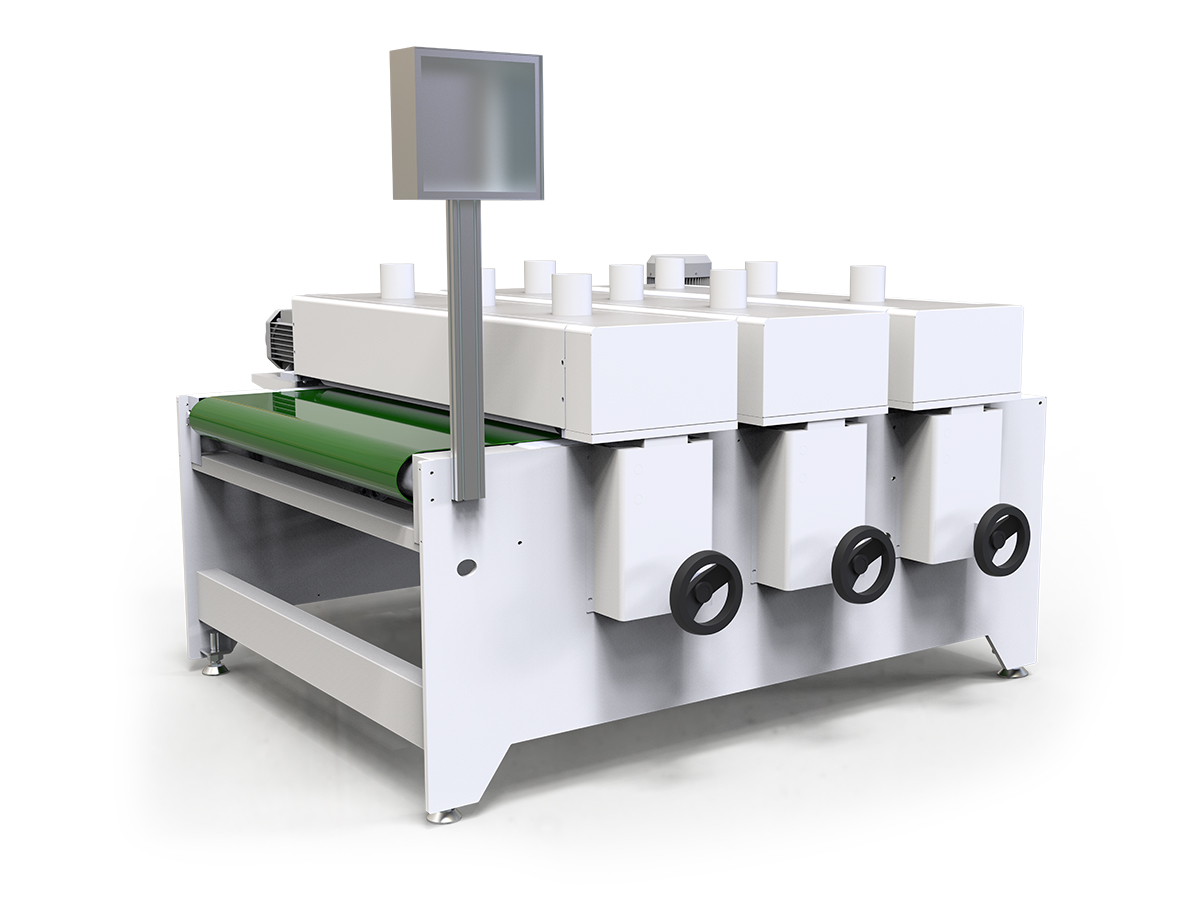
Core Equipment Types in Surface Coating Lines
A complete surface coating line for furniture or panel products integrates several distinct machine categories, each handling a specific stage of the coating process:
Roller Coating Machines
Roller coaters are the most widely deployed application equipment in flat-panel furniture surface treatment. They use precision-ground rubber or steel rollers to transfer a metered film of coating material onto the panel surface. Coating weight accuracy of ±1–3 g/m² is achievable on modern roller coaters, making them suitable for thin-film UV primer and sealer applications where coating thickness consistency directly affects subsequent sanding and top-coat adhesion. Reverse roller configurations allow application of higher-viscosity materials and produce a smoother, more even film than forward roller setups.
Spray Coating Systems
Spray systems — including airless, air-assisted airless (AAA), and electrostatic spray — are used for three-dimensional parts, edge profiles, and applications requiring high film build in a single pass. Electrostatic spray systems achieve transfer efficiencies of 70–85% compared to 30–50% for conventional air spray, significantly reducing coating material waste and VOC emissions. Automated reciprocating spray machines and multi-axis robotic spray cells are used in high-volume furniture component finishing to eliminate operator variability and improve cross-line consistency.
Curtain Coating Machines
Curtain coaters apply coating material as a continuous falling film ("curtain") through which panels pass on a conveyor. This method achieves exceptionally uniform coating thickness across the full panel width, with no roller contact marks and very low material waste since excess coating is recycled back to the supply tank. Curtain coating is particularly suited to water-based and UV-curable sealers at application weights of 20–120 g/m², and is standard equipment in high-output flooring and flat-panel furniture lines.
Vacuum Coating Machines
Vacuum coaters excel in coating profiled components — door frames, moldings, skirting boards, and window profiles — where flat-application methods cannot reach recessed or complex geometries. The substrate passes through a bath of coating material under vacuum pressure, ensuring complete surface coverage including deep channels and sharp inside corners. This technology is widely used in MDF profile coating for kitchen cabinet doors and architectural millwork components.
Wrapping and Membrane Press Machines
For furniture components requiring decorative film or foil application — such as PVC film wrapping on MDF door fronts or thermoforming of decorative laminates over shaped panels — membrane press and profile wrapping machines apply adhesive-coated film under heat and vacuum. These machines are technically surface treatment equipment, and their output quality depends on upstream primer coating consistency, substrate moisture content, and adhesive application uniformity.
Curing and Drying Systems
Application equipment alone does not define a coating line's performance — the curing system determines throughput speed, energy consumption, final film hardness, and chemical resistance of the finished surface. Three principal curing technologies are in use in modern furniture surface treatment:
- UV (ultraviolet) curing: UV-curable coatings polymerize in seconds when exposed to high-intensity UV lamps (mercury vapor or LED). UV curing lines can operate at conveyor speeds of 15–30 m/min, making them the highest-throughput option for flat-panel finishing. UV LED systems offer additional advantages: instant on/off capability, no warm-up time, lower heat output (critical for heat-sensitive veneers and thin substrates), and lamp lifespans of 20,000+ hours versus 1,000–2,000 hours for conventional mercury lamps.
- Hot air convection drying: Standard for water-based and solvent-based coatings, convection ovens circulate heated air at 60–120°C to evaporate the carrier and cure the coating film. Drying tunnel length and air velocity determine throughput; longer tunnels or higher temperatures accelerate drying but risk raising substrate moisture content above acceptable limits for wood-based panels.
- IR (infrared) and NIR (near-infrared) drying: Infrared panels heat the coating film directly rather than heating the surrounding air, reducing energy consumption by 30–50% compared to convection drying for equivalent throughput. NIR technology is particularly effective for water-based coatings because water molecules absorb NIR radiation efficiently, accelerating surface drying without overheating the substrate core.
Hybrid curing configurations — for example, IR pre-drying followed by UV top cure — are increasingly standard in high-performance furniture surface treatment lines, combining the rapid moisture removal of IR with the hardness and scratch resistance achievable only through UV polymerization.
A complete furniture surface treatment line involves more than coating application and curing. The sequence of pre-treatment, application, curing, and finishing operations collectively determines the output quality, and each stage depends on the previous one being executed to specification. A typical flat-panel furniture surface treatment line follows this process sequence:
- Sanding and surface preparation: Wide-belt sanders calibrate panel thickness and remove surface contamination. A consistent Ra surface roughness of 0.8–2.5 µm is the target for most coating systems; excessively smooth surfaces reduce mechanical adhesion of the primer coat.
- Dust removal: Brush and air-blast cleaning stations remove sanding dust before the coating section. Residual dust particles cause fish-eye defects in the wet film and inclusions in the cured coating — among the most common quality failure modes in furniture finishing.
- Primer / sealer application: The first coating layer seals the substrate surface, fills open wood grain or pores in MDF, and creates a uniform base for subsequent coats. Roller coater or curtain coater application at 15–40 g/m² is typical.
- Inter-coat sanding: After primer cure, an intermediate sanding station (typically 320–400 grit) removes surface imperfections and creates the mechanical profile needed for top-coat adhesion. This stage is critical — inadequate inter-coat sanding is the leading cause of top-coat delamination in service.
- Top-coat application: One or more top-coat passes apply the final color, gloss level, and functional surface properties. High-gloss piano-finish surfaces may require three or more top-coat passes with inter-coat polishing between each.
- Final curing: UV, IR, or convection curing of the top coat to achieve full film hardness, chemical resistance, and surface durability specifications.
- Surface inspection and quality control: Automated optical inspection systems or manual raking-light inspection check for defects including inclusions, orange peel, runs, sags, and color variation before panels proceed to cutting and assembly.
Comparing Equipment Configurations by Production Scale
| Production Scale |
Typical Equipment Setup |
Line Speed |
Investment Range (USD) |
| Small workshop / custom |
Manual spray booth + convection oven |
Batch process |
$15,000 – $80,000 |
| Mid-volume furniture factory |
Roller coater + UV curing line + inter-coat sander |
8–15 m/min |
$200,000 – $600,000 |
| High-volume panel manufacturer |
Multi-station curtain coater + UV LED line + auto inspection |
20–30 m/min |
$1,000,000 – $4,000,000+ |
| 3D / profile components |
Robotic spray cell + vacuum coater + IR drying tunnel |
Component-dependent |
$300,000 – $1,500,000 |
Indicative equipment configurations and investment ranges for furniture surface coating lines at different production scales.
Environmental Compliance and Waterborne System Adoption
Environmental regulation is the most significant driver reshaping surface coating equipment specification decisions in the furniture industry. Solvent-based coating systems — historically dominant for their fast cure speed and high-gloss performance — are subject to progressively tighter VOC (volatile organic compound) emission limits in China, the European Union, and North America. China's national standard GB 18582-2020 caps VOC content in interior wood coatings at 120 g/L for water-based products; many provincial regulations are stricter.
The industry response has been a structural shift toward waterborne coating systems and UV-curable zero-VOC formulations. This transition carries direct equipment implications: waterborne coatings require stainless steel or plastic-lined application components (to prevent corrosion), modified roller coater rubber hardness specifications, extended IR pre-drying zones, and higher-capacity exhaust ventilation in enclosed coating stations to manage humidity buildup. Factories retrofitting existing solvent-based lines for waterborne use frequently underestimate these equipment modification requirements, leading to surface defects — particularly raised grain on wood veneer and orange-peel texture on MDF — that trace back to inadequate drying capacity rather than coating formulation.
UV LED curing technology has emerged as a particularly attractive solution for compliance-driven transitions because UV-curable coatings contain negligible VOC content by formulation, require no solvent recovery or abatement systems, and reduce energy consumption by 60–80% compared to mercury UV lamp systems. The global UV LED curing equipment market reached USD 780 million in 2023 and is projected to grow at 14.3% CAGR through 2028, with furniture surface treatment identified as one of the three largest application segments alongside electronics and printing.
Selection Criteria for Surface Coating and Furniture Surface Treatment Equipment
Equipment procurement decisions in this category involve more variables than in most industrial machinery purchases because coating line performance is highly system-dependent — no single machine operates in isolation. The following criteria framework provides a structured basis for equipment evaluation:
- Substrate compatibility: Confirm that all wetted parts — rollers, nozzles, pumps, tanks — are chemically compatible with the intended coating chemistry (solvent-based, waterborne, UV, or oil). Incompatible materials cause swelling, corrosion, and coating contamination.
- Required coating weight range: Application equipment must be capable of metering the full range of coating weights needed across your product mix, from thin sealer coats (5–15 g/m²) to high-build primer applications (40–80 g/m²), without changing rollers or major reconfiguration.
- Line speed and throughput capacity: Calculate required throughput in m²/shift based on production targets, then work backward to determine minimum line speed. Build in a 20–25% capacity buffer for planned maintenance downtime and product changeover time.
- Curing system compatibility with coating supplier: UV lamp spectrum, intensity (W/cm²), and conveyor speed must be validated with the specific UV coating formulations to be used. Undercured coatings — caused by mismatched lamp spectrum or insufficient dose — pass visual inspection but fail scratch, chemical resistance, and cross-hatch adhesion tests in service.
- Automation and process control: Modern coating lines should provide closed-loop control of coating weight (via gravimetric feedback or film thickness sensors), temperature profiling across drying zones, and UV dose monitoring. These controls are essential for maintaining consistent output quality across multi-shift operations and are increasingly required by OEM furniture customers conducting supplier audits.
- Changeover time and flexibility: For factories producing multiple product lines or SKUs with different surface finishes, fast changeover capability — including quick-release roller assemblies, CIP (clean-in-place) coating circuit flushing, and programmable recipe storage — directly impacts productive uptime and scheduling flexibility.
- Supplier technical support and spare parts availability: Coating line downtime is disproportionately costly relative to equipment value. Evaluate supplier service network coverage, average response time for on-site technical support, and local spare parts stocking before committing to a supplier — particularly for imported European or Japanese equipment where parts lead times can exceed 6–8 weeks.



 English
 中文简体
中文简体

